Table of contents
- Table of contents
- Introduction
- Mandatory and Optional Reservations
- Reservation Fees
- Selecting Places
- Place Reallocation
- Fare Reservations and Interoperability with IRS 90918-1
Introduction
Reservations are used to allocate seats or berths to passengers, but also hooks to bicycles and at some carriers to allocate space for items of a passenger (e.g. prams, cars, motorcycles,..).
Reservations might be sold alongside of admissions or ancillaries but can also be sold stand-alone if the passenger already has a ticket.
Reservations might come with an additional fee or an additional price or both. The reservation fee might cover multiple reservations.
A reservation always relates to a single leg, i.e. the tripCoverage attribute
of the ReservationOfferPart can only refer to a single leg, even though the API
syntax allows to specify multiple entries for tripCoverage.coveredLegs, due to
the fact that TripCoverage is used for all offer part types.
Mandatory and Optional Reservations
For some trains a reservation is mandatory. This might be the case due to commercial condition or due to legislation.
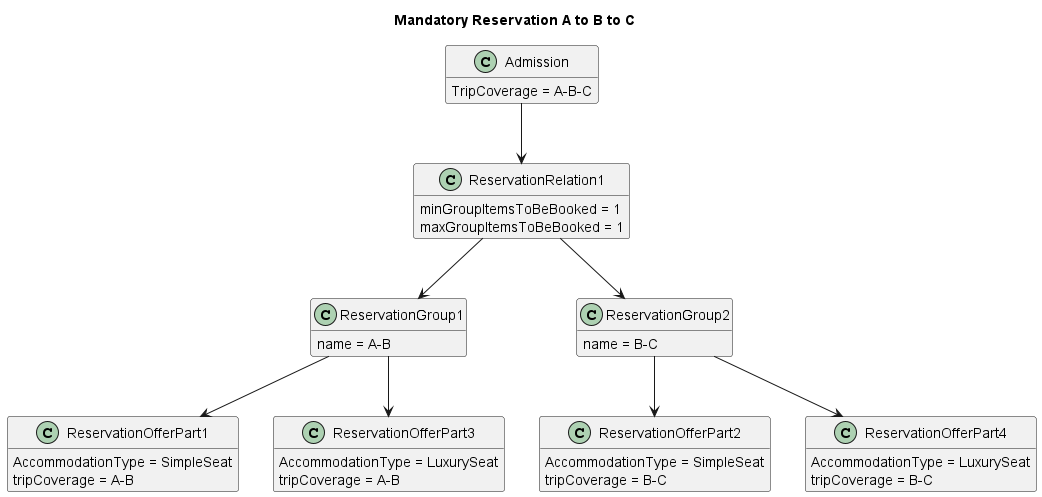
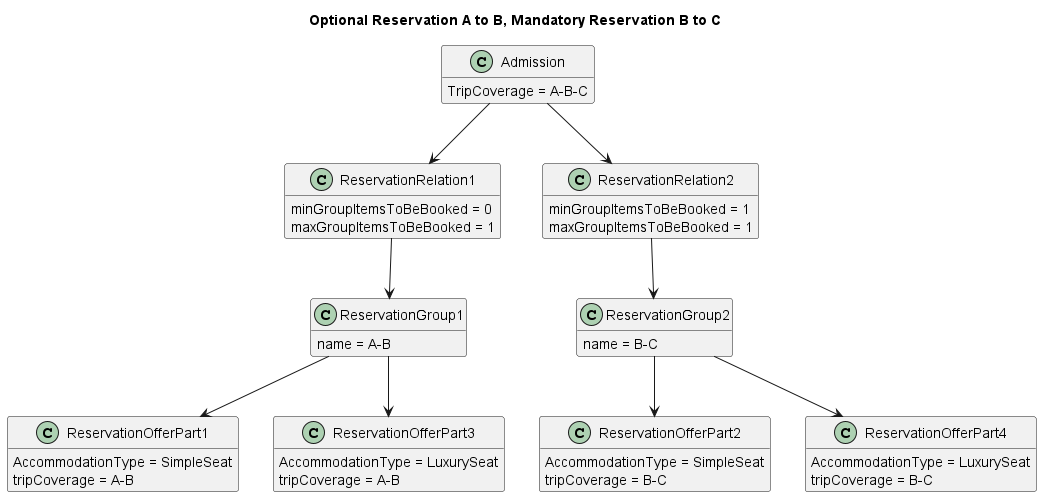
The possible reservations are provided as offer parts with each offer. The retailer must provide the correct selection of reservations for booking in order to have reservations for all trains with mandatory reservations. These rules are provided with the offer parts in the ReservationRelation Object linked to either an admission offer part or an ancillary offer part. An ancillary or an admission can have multiple reservation relations. Each of these needs to be satisfied to make the booking.

Example 1: A reservation is mandatory on both legs, A-B and B-C.
Either a simple seat or a luxury seat can be selected.
Example 2: A reservation is mandatory on leg B-C, the reservation leg on A-B is optional.
Either a simple seat or a luxury seat can be selected.
Reservation Fees
Reservation fees might be taken per leg or per trip. The reservation fees is
included in the offer as a separate object. All reservations that are subject to
the fee link to the fee via feeRef in the reservationOfferPart. The fee is
applied if one of the linked reservations is included in the booking.
If the fee is included in the admission price this can be indicated by the
isIncluded flag in the reservationRelation.
If reservation is optional the reservation fee will not be included in the minimal price shown in the offer summary.
 `
`
Selecting Places
The selection of places is a separate optional API calls. There are separate calls to retrieve:
- a graphical representation of seat availability to provide a graphical UI for seat selection (see the process description on graphical reservation)
- the availability of a seat with a specific set of properties
- the availability of seats nearby a referenced seat
The selected seats need to be added to the reservation using a patch.
Selecting seats is optional. If no seat is selected the provider will allocate them on booking confirmation.
The selection of seats might be subject to fees. This is independent from the reservation fee to getting a reservation and is applied in case the graphical selection is used. This fee might depend on the seat and the fee is shown in the seat availability for the selection. This fee is added to the booking in case of a selection, so it is not part of the original price and changes the total price of the offer.
Place Reallocation
Due to change of vehicles a carrier might have to change the reserved seats.
This is indicated via an Event of type BOOKING_REACCOMMODATED. In case the
passengers e-mail address has been provided the carrier should inform the
passenger directly.
Fare Reservations and Interoperability with IRS 90918-1
OSDM supports product based and fare based sales. Also reservations are supported in the two business models:
Product Based Model:
- Complete products are provided
- Tickets are provided by the provider
- Reservation fees are managed by the provider (as a Distributor)
Fare Based Model:
- Parts of products are provided
- Products are build by the consumer
- Tickets are build by the consumer
- Reservation fees are managed by the consumer (as a Distributor)
The old IRS 90918-1 specification implemented reservations in the fare based model only. Reservations obtained via an converter (H2O converter) from 90918-1 implementations are also in the fare based model.
The modeling of fare based reservations in OSDM has changed over the different versions.
With version 3.8 onwards fare based reservations use the same objects from Reservation and ReservationOfferPart
objects as product based reservations. They are indicated by the OfferPartType: FARE_RESERVATION.
In the offer request one specifies the requested part type:
OfferSearchCriteria.requestedOfferParts.OfferPartType = FARE_RESERVATION
In the reply the fare reservation offer part is indicated by:
ReservationOfferPart.distributionMode = FARE_MODE(versions 3.8, .. 3.xx)ReservationOfferPart.partType = FARE_RESERVATION(version 4.0)Reservation.distributionMode = FARE_MODE(versions 3.8, .. 3.xx)Reservation.partType = FARE_RESERVATION(version 4.0)
In this case, the client produces the fulfillment. On servers side, there is a fulfillmentId only.
Consequently, a call of GET /fulfillments/{fulfillmentId}will either return an error or an empty
fulfillment.
Handling of the IRS 90918.1 reference number for OSDM purposes: this legacy number is numeric and 12 digits long. It consists of the reservation system number and a 10-digit ID. Since this number is still used on some reservation tickets and is also used for accounting purposes, it should be stored in the booking under bookedOffers[]/reservations[]/bookingPartCode. This requires a 1:1 relationship between a bookedOffers[]/reservations[] entry and the corresponding reservation in the inventory system.