Table of Contents
- Table of Contents
- The Challenge
- The Goal
- The Hub File
- Schema Domains (14 core + 5 OJP files)
- OJP Schemas (5 files, 54 schemas)
- Path Domains (24 files)
- How
$refLinking Works - Fare / Product Separation
- Packages per Role — Summary Table
- CI Pipeline Update
- What Changes for Consumers?
- What Changes for Maintainers?
The Challenge
The Online API spec is one single 18,112-line YAML file with 69 endpoints and 546 schemas. Contributors must navigate the entire file to find what they need.
Several pain points arise from this monolithic structure:
- Merge conflicts — parallel work on different domains collides in one file
- Cognitive overload — a fulfillment developer must scroll past 12,000 lines of unrelated schemas
- Review friction — every PR diff spans the entire monolith, obscuring the actual change
- Onboarding — new contributors can’t find a starting point in 18K lines
The Goal
Split the monolith into domain-aligned modules while:
- Keeping the spec valid OpenAPI 3.0.3
- Producing an identical bundled output for consumers
- Requiring no changes from API implementers
- Aligning with existing tag structure already in the spec
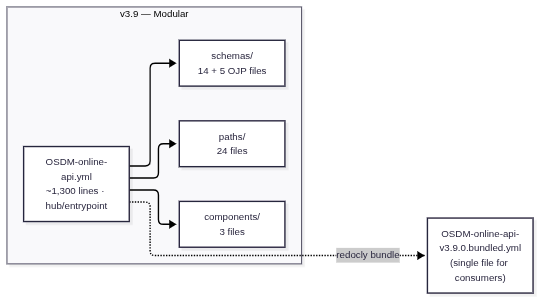
The structure breaks the monolith into hub, paths, schemas, and components, making it easier to navigate and maintain.
The Hub File
OSDM-online-api.yml is the single entrypoint — ~1,300 lines
Contains:
openapi,info,servers,tags,security- All
pathsas$refpointers topaths/*.yml - All
components/schemasas$refpointers toschemas/*.yml - All
components/parameters,responses,securitySchemesas$refpointers
Consumers and tools always start here.
Schema Domains (14 core + 5 OJP files)
| File | Schemas | Domain |
|---|---|---|
_common.yml |
92 | Problem, Price, Links, Currency, … |
place.yml |
55 | CoachLayout, PlaceAvailability, Compartment |
offer.yml |
42 | Offer, Admission, Reservation, Ancillary |
aftersales.yml |
38 | Refund, Exchange, Release, Cancel |
booking.yml |
34 | Booking, BookedOffer, Split |
fulfillment.yml |
32 | Fulfillment, Document, Security |
trip.yml |
30 | Route, Section, TrainLink, TripAllocation |
fare.yml |
24 | Fare, Zone, RegionalValidity, TravelValidity |
passenger.yml |
23 | Passenger, Purchaser, ReductionCard |
| + 5 more | 70 | Complaint, Transport, Travel Account, … |
OJP Schemas (5 files, 54 schemas)
Schemas originating from the Open Journey Planner standard:
| File | Schemas | Domain |
|---|---|---|
ojp/trip.yml |
26 | Trip, TimedLeg, Board, Alight, DatedJourney |
ojp/_common.yml |
13 | Address, GeoPosition, Mode, ModeFilter |
ojp/place.yml |
11 | Place, PlaceRef, PointOfInterest |
ojp/product.yml |
2 | ProductCategory, ProductCategoryRef |
ojp/continuous-service.yml |
2 | ContinuousMode, ContinuousService |
Separating OJP schemas clarifies the boundary between OSDM and OJP — these types are consumed, not owned.
Path Domains (24 files)
| File | Endpoints | Lifecycle Stage |
|---|---|---|
trips.yml |
4 | Search & Discovery |
offers.yml |
4 | Offer & Selection |
bookings.yml |
4 | Booking Management |
booked-offers.yml |
3 | Booking Management |
booking-parts.yml |
6 | Booking Management |
fulfillments.yml |
4 | Fulfillment |
refund.yml |
3 | After-Sales |
exchange.yml |
3 | After-Sales |
availabilities.yml |
5 | Search & Discovery |
| + 15 more | 33 | Various |
How $ref Linking Works
# Hub (OSDM-online-api.yml)
paths:
  /trips:
    $ref: ./paths/trips.yml#/~1trips # ← path file

components:
  schemas:
    Trip:
      $ref: ./schemas/trip.yml#/Trip # ← schema file


# Schema files cross-reference each other:
# schemas/booking.yml → ./passenger.yml#/Passenger    (cross-domain)
# schemas/trip.yml    → ./_common.yml#/Price           (common types)
Fare / Product Separation
The original product.yml (38 schemas) mixed two concerns — split into:
fare.yml (24 schemas) |
product.yml (12 schemas) |
|---|---|
| Fare, FareType, FareCombinationModel | Product, ProductType, ProductSummary |
| RegionalConstraint, RegionalValidity | ProductSearch/Response/Collection |
| Zone, ZoneDefinition, ZoneCollection | ProductTag, ProductTagGroup |
| TravelValidity, TrainValidity | PromotionCodeCollection |
| CarrierConstraint, LuggageConstraint |
Why? Fare schemas are referenced by offer, booking, aftersales, fulfillment, and travel-account — a distinct dependency cluster. Product schemas serve the catalog API.
Packages per Role — Summary Table
| Package | Fare Provider | Distributor | Retailer |
|---|---|---|---|
_common, ojp/* |
mandatory | mandatory | mandatory |
offer, booking, passenger |
mandatory | mandatory | mandatory |
fulfillment |
mandatory | mandatory | mandatory |
product |
mandatory | mandatory | mandatory |
trip |
optional | mandatory | mandatory |
fare |
mandatory | mandatory | n/a |
aftersales |
mandatory | mandatory | optional |
place, transportable |
optional | optional | optional |
complaint, travel-account |
n/a | optional | optional |
CI Pipeline Update
# .github/workflows/validate-openapi.yml
steps:
  - name: Bundle modular v3.9 spec
    run: >
      redocly bundle
        specification/v3.9/OSDM-online-api.yml
        --output specification/v3.9/OSDM-online-api-v3.9.0.bundled.yml

  - name: Validate OpenAPI documents
    run: >
      redocly lint --format=github-actions
        specification/**/*.yml
What Changes for Consumers?
Nothing.
- The bundled
.ymlfile is the same format as before - Swagger UI and Redoc render identically
- No API changes, no breaking changes
- Consumers never see the modular source files
The modularization is purely an internal maintainability improvement.
What Changes for Maintainers?
| Before | After |
|---|---|
| Edit 1 file (18K lines) | Edit the relevant domain file |
| Merge conflicts on every PR | Conflicts only when same domain is touched |
| Full-file diffs in reviews | Focused diffs on the changed domain |
| Grep through 18K lines | Open the domain file directly |
New workflow:
- Edit
schemas/booking.ymlorpaths/refund.yml - Run
redocly bundleto produce the bundled file - Run
redocly lintto validate - CI does this automatically on push/PR